The Security Visibility Paradox
Table of Contents
The Security Visibility Paradox: An Internal Pentester’s Analysis of Trust Concentration in AI-Based Security Platforms
Summary
The modern breed of AI-based security tools (SIEM, XDR, autonomous penetration testing tools) is capable of detecting threats because of the aggregation of telemetry on the entire enterprise level. Nonetheless, there is the Security Visibility Paradox inherent to such an approach to security—namely, the need for infrastructure integrations that enable security teams to have full visibility also results in the creation of highly privileged entities that can be abused by intruders.
This analysis adopts the perspective of an internal penetration tester to examine how concentrated trust relationships can be abused after initial compromise.
Introduction
In order to spot complex attacks, security systems using AI should be provided with large volumes of telemetry originating from Active Directory (AD), endpoint agents, cloud workloads, and networks. In order to accomplish this task, companies grant security platforms broad read/write privileges across domains through service accounts, API keys, and managed identities.
Although centralization of telemetry helps defensive AI to spot patterns and anomalies, it also introduces a concentration of trust. Integration points serve as architectural chokepoints at which enterprise identity, endpoint management, and clouds merge.
From the attacker’s point of view, these integrations become an optimal shortcut. The architecture built to facilitate complete “visibility” inadvertently creates a unique vector of “vulnerability” targeting machine identities.
Despite these risks, AI-driven security platforms remain essential for modern threat detection because they enable defenders to correlate events across complex enterprise environments.
The central argument of this paper is that AI-based security platforms derive their effectiveness from enterprise-wide visibility, but the trust required to achieve that visibility can unintentionally create high-value attack paths for internal adversaries.
Network Architecture with AI Security Integration
In a typical enterprise deployment, the AI security platform sits adjacent to the primary data repositories, maintaining persistent connections across all corporate tiers.
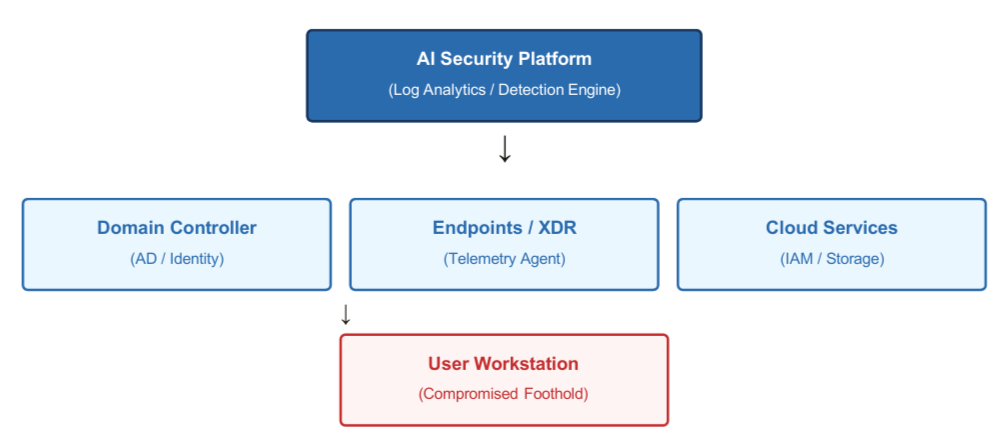 Every operational link in this architecture relies on persistent authentication.
Whether it is a log forwarder running with domain privileges or a cloud connector syncing IAM audit logs, these connections rely heavily on high-privilege service accounts that frequently suffer from configuration drift and over-permissioning.
Threat Model and Objective
This analysis assumes a post-exploitation scenario in which an attacker has already obtained access to a low-privilege workstation inside the enterprise network.
In this case, the aim is not to interfere with or attack the machine learning models in the AI platform but to map out the trusted relations in place for its use.
Trust Concentration Analysis & Enumeration
The internal attacker does not require any administrative privilege to get started on footprinting the AI platform.
Since security integration needs to communicate with the entire directory structure, these account identities can be enumerated with a regular domain query.
As opposed to looking for a vulnerability in a specific system, the attacker can focus on identifying naming conventions and Service Principal Names (SPNs) associated with security tools.
# Querying the directory for service accounts mapped to security or monitoring platforms

Get-ADUser -Filter 'Name -like "svc-*"' `
-Properties Name, Description, ServicePrincipalName
Discovery of an account named something like:
svc-siemsvc-xdrsvc-ai-analytics
immediately reveals the defensive framework of the organization.
The most crucial vulnerability at play in this scenario is that of Trust Concentration.
Upon reviewing the membership groups of these identified accounts, attackers may discover that these identities have:
- Extensive read access to Domain Controller event logs
- Access to backup software
- Permission to log on as a service
- Cross-tier visibility privileges
- Cloud integration permissions
Attack Path Analysis
Once a privileged security service account is identified, the attack flow shifts from discovery to exploitation, leveraging the platform’s trusted status to compromise the broader domain.
- Foothold : Low-Privilege User Workstation
- Enumeration : Identify Non-Human Security Accounts via AD Queries
- Credential Acquisition : Extract Tokens from Configurations or Memory
- Abuse of Trust : Misuse Over-Privileged Security Identities
- Accelerated Reconnaissance : Query Aggregated SIEM Logs to Map Targets
- Domain Impact : Compromise Cloud IAM and Tier-0 Assets
Importantly, this type of lateral movement can remain highly stealthy.
As the accounts belonging to the security service are expected to conduct automated cross-tier activities around the clock, their actions often blend seamlessly with legitimate operational behavior.
Automated collection of data from such an account can be indistinguishable from normal telemetry gathering.
Detection Gaps and Blind Spots
Defenders face severe visibility limitations regarding their own security tooling due to several core blind spots.
1. The Non-Human Baseline Problem
Security solution accounts constantly interact with thousands of endpoints every day.
Because these accounts naturally generate large volumes of activity, identifying anomalous behavior becomes extremely difficult.
Attackers can therefore blend into legitimate administrative traffic.
2. Trust Islands
To avoid excessive alerts generated by their own security infrastructure, defenders frequently exclude these service accounts from continuous monitoring.
This creates isolated trust zones where suspicious activity may go unnoticed.
3. Decentralized Log Manipulation
If a security solution’s service account has access to central logging repositories, attackers may be able to:
- Delete evidence
- Modify logs
- Disable log connectors
- Suppress alerts
4. Inherited Trust Assumptions
AI-based monitoring systems often inherit the trust assumptions of the infrastructure they monitor.
As a result, compromise of trusted identities becomes difficult to distinguish from legitimate administrative activity.
Mitigations and Validation Checks
Strong Least Privilege
Security accounts should never be granted generic administrative roles in either on-premises or cloud environments.
Connectors should be restricted to predefined, read-only data sources whenever possible.
Managed Identities and Automation
Eliminate static passwords for security tooling.
Adopt:
- Group Managed Service Accounts (gMSAs)
- Managed Identities
- IAM Roles
Benefits include:
- Automatic credential rotation
- Reduced credential theft risk
- Elimination of hardcoded secrets
Network and Architectural Segmentation
Isolate:
- Log collectors
- SIEM management servers
- AI analytics engines
into dedicated, highly restricted network segments.
A compromise of a standard corporate subnet should not provide direct access to security platform administration interfaces.
Targeted Identity Monitoring
Implement dedicated behavioral monitoring for non-human identities.
Trigger high-severity alerts for:
- Unexpected workstation logons
- Unapproved IP addresses
- Unauthorized maintenance windows
- Abnormal authentication patterns
Defensive Penetration Testing
Red-team exercises should explicitly include security infrastructure within their scope.
Organizations should routinely simulate:
- Theft of security API keys
- Service account token compromise
- Connector abuse scenarios
This validates that monitoring controls can detect abuse before domain-wide compromise occurs.
Conclusion
AI-driven security platforms provide defenders with unprecedented visibility across enterprise environments.
However, from an internal pentester’s perspective, this visibility comes with a significant trade-off.
The Security Visibility Paradox suggests that as the reach and capability of a defensive platform expands, the potential impact of compromise increases substantially if the identities, integrations, and trust relationships supporting that platform are abused.
Organizations can mitigate these risks by recognizing that security capabilities are not value-neutral—they carry substantial privilege.
Ultimately, the effectiveness of AI-driven security depends not only on detection accuracy but also on the security of the identities, integrations, and trust relationships that enable those capabilities.