Keystroke Logging System
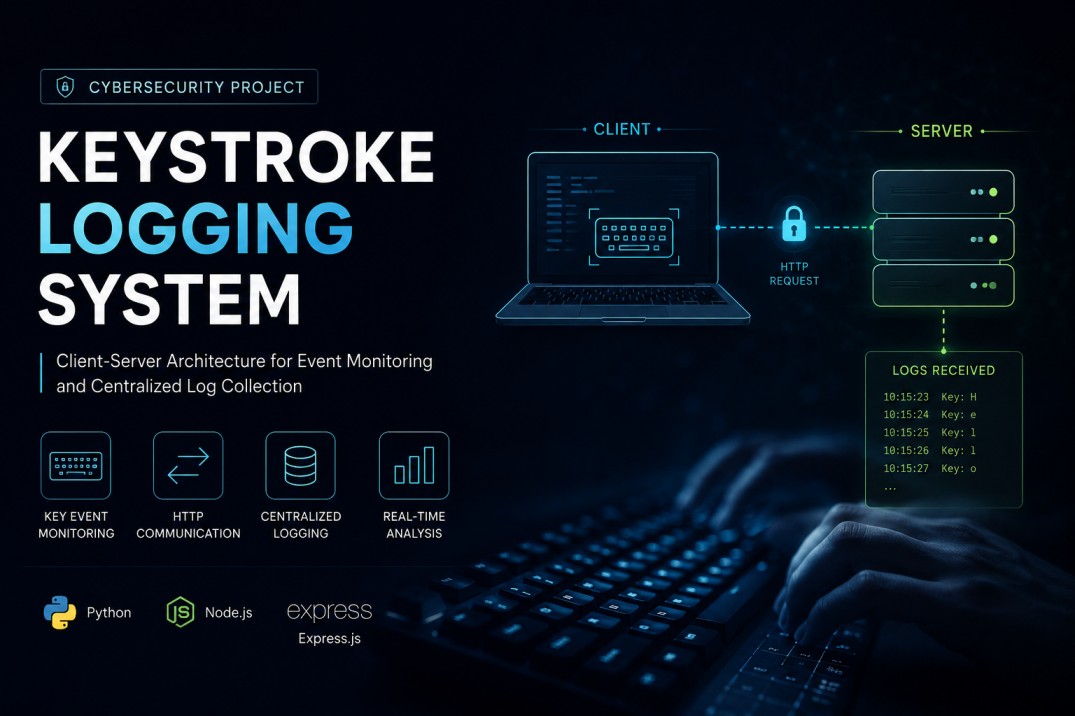
An educational client-server monitoring system demonstrating event capture, network communication, and centralized log collection.
Project Overview
The Keystroke Logging System is an educational cybersecurity project developed to explore how endpoint-generated events can be collected, transmitted, stored, and analyzed through a centralized logging architecture.
The project demonstrates fundamental concepts used in cybersecurity research, digital forensics, security monitoring, and malware analysis by implementing a client-server model that captures user-generated events and securely transmits them to a centralized server for storage and analysis.
Developed using Python, Node.js, and Express.js, the project provided practical experience with network communication, event handling, logging systems, and client-server application development.
⚡ Built for cybersecurity education, research, and controlled laboratory environments.
System Architecture
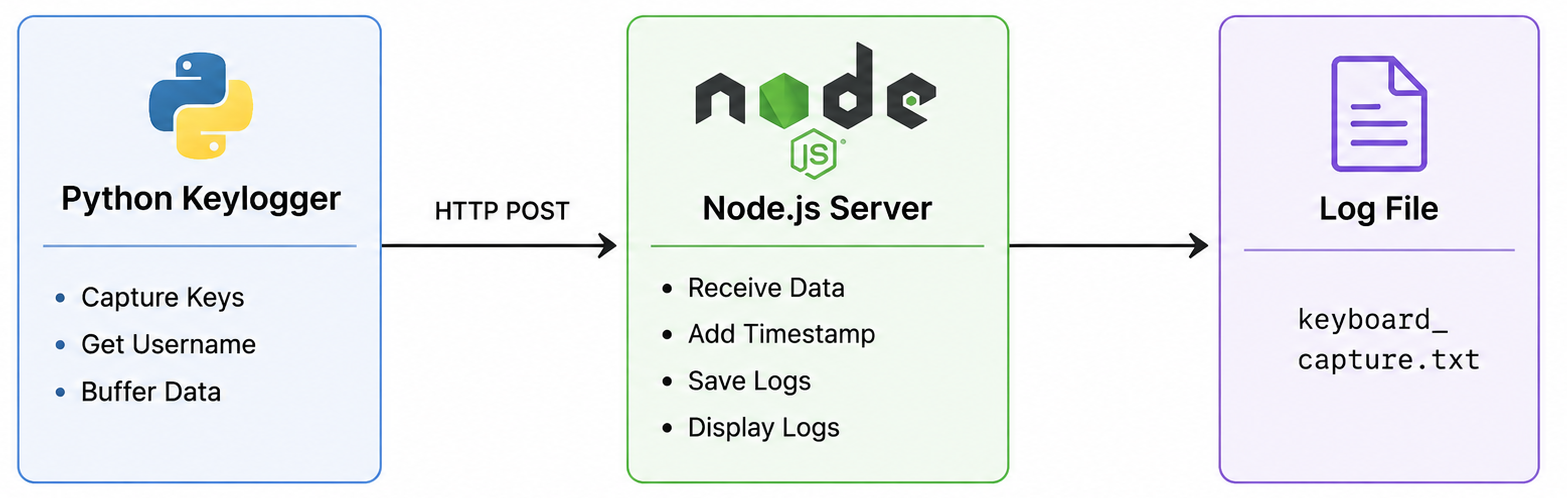
The system follows a client-server architecture:
Client Component
The client application is responsible for:
- Monitoring keyboard events
- Capturing event data locally
- Formatting collected information
- Transmitting data to the server through HTTP requests
Server Component
The server is responsible for:
- Receiving incoming client data
- Processing transmitted information
- Storing collected logs
- Providing centralized log management
Communication Layer
- HTTP-based communication
- Structured data exchange
- Lightweight client-server interaction
- Centralized collection model
Key Features
Event Monitoring
Captures and processes endpoint-generated keyboard events for educational analysis and research purposes.
Centralized Log Collection
Demonstrates how data from distributed clients can be aggregated and stored on a central server.
Network Communication
Implements communication between client and server components using HTTP requests.
Real-Time Data Transmission
Supports near real-time transfer of collected events from client to server.
Modular Architecture
Designed with separate client and server components to improve maintainability and scalability.
Technical Highlights
- Client-server application design
- Network communication using HTTP
- Event-driven programming
- Log collection and management
- Data transmission workflows
- Backend API development
- Security monitoring concepts
- Cybersecurity research methodologies
Challenges Faced
Several technical challenges were encountered during development:
- Designing reliable client-server communication
- Managing event collection efficiently
- Handling network connectivity issues
- Structuring collected data for storage
- Creating a scalable logging workflow
- Ensuring system stability during continuous operation
Addressing these challenges improved my understanding of distributed systems and security monitoring architectures.
Skills & Knowledge Gained
Through this project, I gained practical experience in:
- Python application development
- Node.js backend development
- Express.js server implementation
- Network communication concepts
- Client-server architecture design
- Security monitoring principles
- Logging system implementation
- Data collection and analysis workflows
Educational Value
This project was developed as a cybersecurity learning exercise to better understand:
- How monitoring systems operate
- Event collection mechanisms
- Centralized logging architectures
- Network-based data transmission
- Security operations workflows
- Malware analysis concepts
The implementation provides insight into both defensive monitoring systems and techniques commonly studied during cybersecurity research.
Ethical & Security Considerations
This project was created strictly for educational purposes, cybersecurity research, and controlled laboratory environments.
The project is intended to help understand event monitoring, logging systems, and client-server communication concepts. It does not include advanced offensive functionality such as persistence mechanisms, privilege escalation, process injection, credential extraction, or evasion techniques.
Users should only deploy and test the project in environments where they have explicit authorization.
Future Improvements
- Secure encrypted communication
- Authentication mechanisms
- Role-based access controls
- Log visualization dashboard
- Event filtering and categorization
- Alert generation system
- Database-backed storage
- Enhanced analytics and reporting
Technologies Used
Programming Languages
- Python
- JavaScript
Backend
- Node.js
- Express.js
Networking
- HTTP Communication
- REST Concepts
Security Concepts
- Event Monitoring
- Log Collection
- Centralized Logging
- Security Research
Project Outcome
This project strengthened my understanding of cybersecurity monitoring concepts, client-server application development, network communication, and centralized logging systems. It provided valuable hands-on experience with technologies and methodologies commonly encountered in security operations, malware analysis, and cybersecurity research.
Github Repo
🌐 Get the github repository here
https://github.com/zer0arc4/Keystroke-Logging-System.git

Related Posts
Cryptographic Hash Generator
A responsive client-side security tool that generates hashes using MD5, SHA-1, SHA-2, SHA-3, and BLAKE2 algorithms while …
Future Security Tools
A collection of planned security tools including recon automation, payload generators, and lab utilities.
RootMe | TryHackMe Writeup
Compromised the RootMe machine by discovering the hidden /panel/ directory, bypassing the PHP upload restriction with a …
TheDoor | VulNyx Writeup
Compromised TheDoor by abusing anonymous FTP to obtain an information-disclosing email, discovering hidden numbered web …